Payslip vs Pay Stub vs Salary Slip: The Difference
Payslip, pay stub and salary slip are three names for the same document. What genuinely changes between countries is not the name but the fields the law requires on it.
A payslip, a pay stub and a salary slip are the same document. One employer, one employee, one pay period: what was earned, what was taken off, and what was actually paid. The word changes with the country you are standing in, and nothing about the paper changes with it.
That is the whole answer to the question, and most pages stop there. The more useful question is the one underneath it: if the name does not matter, what does? The answer is the fields. What a payslip must legally show varies a great deal between countries — far more than the vocabulary does — and that is the part worth knowing, whether you are reading one or producing one.
Where each name is used
These are tendencies, not rules. Plenty of American companies running global payroll say "payslip", and Canadians use both freely.
Pay stub — United States and Canada
The oldest and most literal of the names. When wages came as a printed cheque, the stub was the perforated strip you tore off and kept: the cheque went to the bank, the stub stayed with you as the record of how the figure was reached. The paper cheque has largely gone; the word stayed.
You will also meet pay statement, earnings statement and check stub in the US, often within the same company. "Paystub" as one word is at least as common as two, and neither is more correct.
Payslip — UK, Ireland, Australia, New Zealand, South Africa, Singapore
The standard term across most of the Commonwealth, written as one word or two. Wage slip is older British usage that survives for hourly and weekly pay, and pay advice turns up in formal HR and public-sector contexts.
Salary slip — India, Pakistan, Bangladesh, and much of the Middle East
Common across South Asia and widely used in the Gulf. Salary statement and salary certificate also appear, though a salary certificate is often a different document — a letter confirming employment and pay for a bank or an embassy, rather than the per-period breakdown.
And elsewhere
Germany has the Lohnabrechnung or Gehaltsabrechnung, France the bulletin de paie, Italy the busta paga — literally "pay envelope", another name that outlived the object it described.
What does not change: the anatomy
Whatever it is called, the document answers three questions about one pay period, and it answers them in the same order almost everywhere:
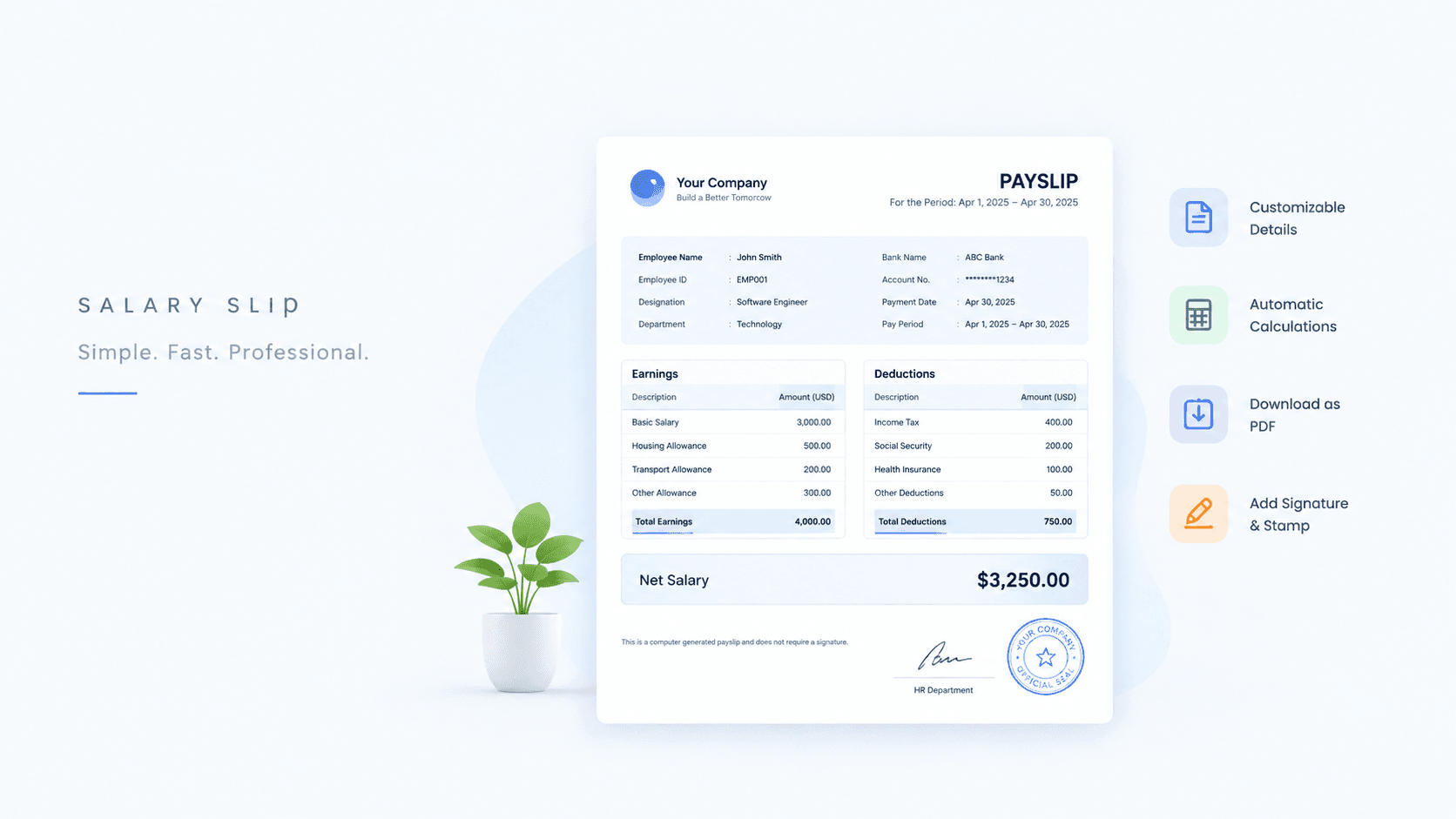
Who and when — employer, employee, the period covered, and the date of payment.
What was earned — basic pay, then overtime, allowances, bonuses and anything else, each on its own line, adding to gross.
What was taken off — tax, social contributions, pension, anything else, each named and each with an amount.
What was paid — net pay, which is gross minus deductions and the only figure that should match the bank transfer.
Most payslips also carry year-to-date totals, so an employee can see the running annual picture without keeping every slip to hand.
This is why a payslip generator does not need to know which word you use. The fields are the same; only the labels change.
What does change: what the law requires
Here the differences are real, and they are larger than most people expect. There is no single international rulebook that says what a payslip must contain.
United Kingdom
Under section 8 of the Employment Rights Act 1996, an itemised pay statement is a legal right, and since April 2019 it belongs to every worker, not only to employees. Government guidance puts the practical requirements plainly: payslips must be provided on or before payday, and the employer chooses whether they are printed or electronic.
The statement has to show earnings before and after deductions, the amount and purpose of any variable deductions, and — where pay varies by time worked — the number of hours being paid for.
Note the edges: the right does not extend to contractors, police officers, merchant seamen or share fishermen.
Germany
Section 108 of the Gewerbeordnung requires a statement in text form at the time wages are paid, covering the accounting period and the composition of pay — the type and amount of any supplements and allowances, and the type and amount of deductions, advances and part-payments.
One detail that surprises people: the statement is not required where nothing has changed since the last proper one. In practice most employers issue one every period anyway, but "German law requires a payslip every month" is not quite right.
United States
There is no federal requirement to give an employee a pay statement at all. This catches people out constantly, because the federal rules that do exist are about the employer's records rather than the employee's copy. The Department of Labor's recordkeeping requirements oblige an employer to preserve payroll records — they say nothing about handing anything over.
Pay statements in the US are a matter of state law, and the states differ widely. Some require an itemised statement every pay period, some require one on request, and some require nothing at all. There is no single answer, which is exactly why "your payslip must show X" is only ever true of one jurisdiction.
Why this matters more than the name
A payslip that satisfies UK requirements may be missing fields an Indian or German employee would expect, and a US pay stub may be missing things both would consider basic. If you are producing payslips for people in more than one country, the document you standardise on has to be the union of those requirements, not the intersection.
The abbreviations are where it gets genuinely confusing
The layout travels; the shorthand does not. The same three letters can mean different things in different places, and this is a more common source of confusion than the name of the document itself.
YTD — year to date. Universal, but the year is not: the UK tax year starts 6 April, India's 1 April, Australia's 1 July, and the US calendar year 1 January. The same label resets on four different days.
PAYE — Pay As You Earn, the UK and Irish system of deducting income tax at source.
NI — National Insurance in the UK. Elsewhere the same two letters more often mean a national identity number, which is not a deduction at all.
FICA — the US payroll tax funding Social Security and Medicare.
CPP / EI — Canada Pension Plan and Employment Insurance.
TDS — Tax Deducted at Source, India's withholding mechanism.
PF / EPF / ESI — Indian provident fund and state insurance contributions.
Super — superannuation in Australia, the employer's pension contribution, usually shown even though it is not deducted from pay.
If you are reading a payslip from a country you have not worked in, assume nothing from the abbreviation and look for the amount and the label together.
Does it matter which word you use?
In conversation, no. Everyone in payroll understands all three.
It matters in two narrow places. The first is formal requests — if a bank, a landlord or an immigration office asks for "three recent pay stubs", give them the document, not a correction of their vocabulary. The second is HR policy in a company spanning several countries, where one term used consistently saves a surprising amount of confusion.
Practical rule: use whichever word the person asking used.
How long payslips are kept, and by whom
Two different clocks here, and they belong to two different parties.
Employers have retention duties. In the US, the Department of Labor requires payroll records to be preserved for at least three years, with the underlying records that wage calculations were based on — time cards, wage-rate tables, schedules — kept for two. Separately, the IRS asks for employment tax records to be kept for at least four years after filing for the year. State rules can require longer.
Employees generally have no legal retention duty at all, which is worth saying plainly, because plenty of advice implies otherwise. Keeping them is practical, not obligatory: payslips are what you check a tax code against, what you produce when a bank asks, and what settles a dispute about what you were paid. A common habit is to keep the last two or three years, plus any year with something unusual in it.
If you have lost one, ask the employer rather than reconstructing it yourself — they are very likely still holding it under one of the duties above.
Making one, whatever you call it
The free payslip generator asks for the fields rather than the name: employer and employee, the period, earnings on separate lines, deductions on separate lines, and it works out the net figure. It produces a clean PDF, and the same layout serves as a payslip, a pay stub or a salary slip depending only on what you head it with.
One condition, and it is the same one the tool itself states: a payslip is a statement of fact about money that actually changed hands. Use it if you run the payroll, or if your employer will check and approve what you prepare. A document showing pay that was never made is fraud in essentially every country, and the institutions that ask for payslips cross-check them against bank statements as routine.
If what you actually need is to produce one rather than name it, the guide to creating a salary slip PDF walks through the format and the fields step by step.
The short version
Payslip, pay stub, salary slip: three names, one document, and the name is the least interesting thing about it. What genuinely differs is what the law in a given country requires the document to show — and on that, the UK, Germany and the United States do not agree with one another at all.
FAQs
Yes. They are two names for the same document: the record of what one employee earned in one pay period, what was deducted, and what was actually paid. Pay stub is the usual term in the United States and Canada, payslip across the UK, Ireland, Australia and much of the Commonwealth. Nothing about the document itself differs.
Most commonly a pay stub, written as one word or two. Pay statement, earnings statement and check stub all appear as well, sometimes within the same company. American employers running international payroll often say payslip too, so the terms are not strictly divided by country.
Yes. Salary slip is the standard term across India, Pakistan, Bangladesh and much of the Middle East for the same per-period document. Be careful not to confuse it with a salary certificate, which is usually a different thing: a letter confirming employment and pay for a bank or an embassy, rather than a breakdown of one pay period.
Both are used and neither is more correct. Two words is more common in formal and legal writing; one word is very common online and in product names. No style guide has settled it, and no institution will reject a document over the spelling.
Electronic payslips are accepted in most places that require payslips at all. UK government guidance, for example, states that the employer decides whether to provide printed or electronic payslips. That said, whether a particular recipient — a specific lender, landlord or embassy — accepts a PDF is their decision, not a matter of payslip law.
It depends entirely on the country. In the UK an itemised pay statement is a statutory right for every worker under the Employment Rights Act 1996, and Germany requires one under the Gewerbeordnung. The United States has no federal requirement at all — federal rules oblige employers to keep payroll records, not to hand a statement to the employee, and pay statement rules are set state by state.
Gross pay is everything earned before anything is taken off: basic pay plus overtime, allowances and bonuses. Net pay is what is left after deductions such as tax, social contributions and pension. Net pay is the figure that should match the amount that arrived in the bank, and if it does not, something on the payslip is wrong.
As an employee you generally have no legal obligation to keep them at all. The retention duties fall on employers: the US Department of Labor requires payroll records to be preserved for at least three years, and the IRS asks for employment tax records to be kept at least four years. Keeping two or three years of your own is practical rather than required, for checking tax codes and answering requests from banks.
Ask the employer or their payroll provider first. Retention rules mean they are very likely to still hold it, and a copy issued by them is the only version anyone will treat as genuine. Do not reconstruct one yourself to stand in for a document you cannot find, because a payslip is a statement of fact about a payment that was actually made.