Company Seal vs Company Stamp: What's the Difference (and Which Do You Need)?
Clear explainer of company seal vs company stamp - legal differences by region, what to put on each, and how to create one free online.
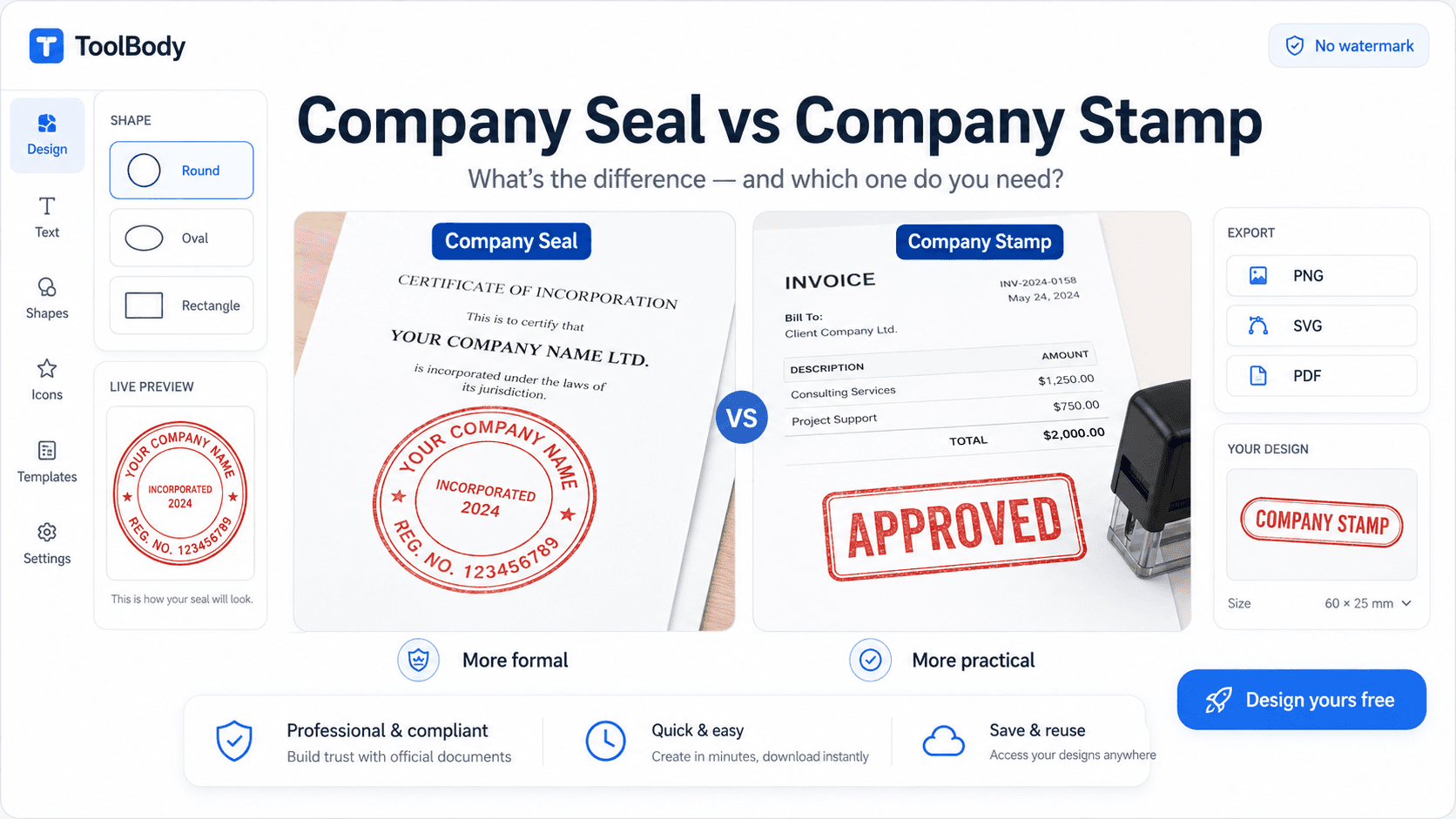
A company stamp is an ink or digital mark carrying your business name and details, used to show a document came from your company. A company seal is a formal embossing device that presses your registered name into the paper, used for legally significant documents such as share certificates and deeds. Most small businesses need only a stamp.
The short version: a stamp identifies, a seal authenticates. Stamps are used daily on invoices, quotations, delivery notes and receipts, and no law requires one. Seals are rare, are governed by company law, and in the UK, India and Australia they are now optional rather than mandatory — which is why most companies registered today never have one made.
A common moment for small business owners and startup founders: you're setting up your company, you've seen formal documents that include some kind of round official mark, and you need to know if you need one. But which is it - a seal or a stamp? Are they the same thing? Is one legally required and the other not? And how do you actually get one for your business?
This guide answers all of that clearly. By the end, you'll know what each term means, which one your business actually needs, and how to design one in about three minutes using a free online tool.
What is a company stamp?
A company stamp is a general-purpose ink stamp - or its digital equivalent as a PNG image - used by a business to mark documents with its identity. The stamp typically contains the company's name, sometimes a logo, sometimes contact details or a tax registration number. The format is usually round, oval, or rectangular.
What a company stamp does:
Marks documents as coming from the business
Adds a layer of visual authority to business correspondence
Helps clients recognize your invoices, quotations, contracts, and other documents
Serves as a brand element across packaging, letterheads, certificates, and internal workflow documents
What a company stamp does not do (in most jurisdictions):
Carry independent legal authority - it doesn't make a document legally binding on its own
Authenticate the company as a legal entity in formal corporate proceedings
Replace a notary's seal, court stamps, or other regulated authority marks
In practical terms, a company stamp is a branding and identification mark. It says "this came from us" but doesn't say "this is legally binding because of the stamp itself."
Typical company stamp examples
A round stamp with your company logo in the center and company name on the curved arcs
A rectangular stamp with your company name, address, and phone number for return-mail use
A bilingual stamp with English on top and Arabic on the bottom (standard for UAE and GCC businesses)
A workflow stamp like "PAID" or "RECEIVED" branded with your company name
All of these are company stamps. Any of them can be designed in the free online stamp maker.
What is a company seal?
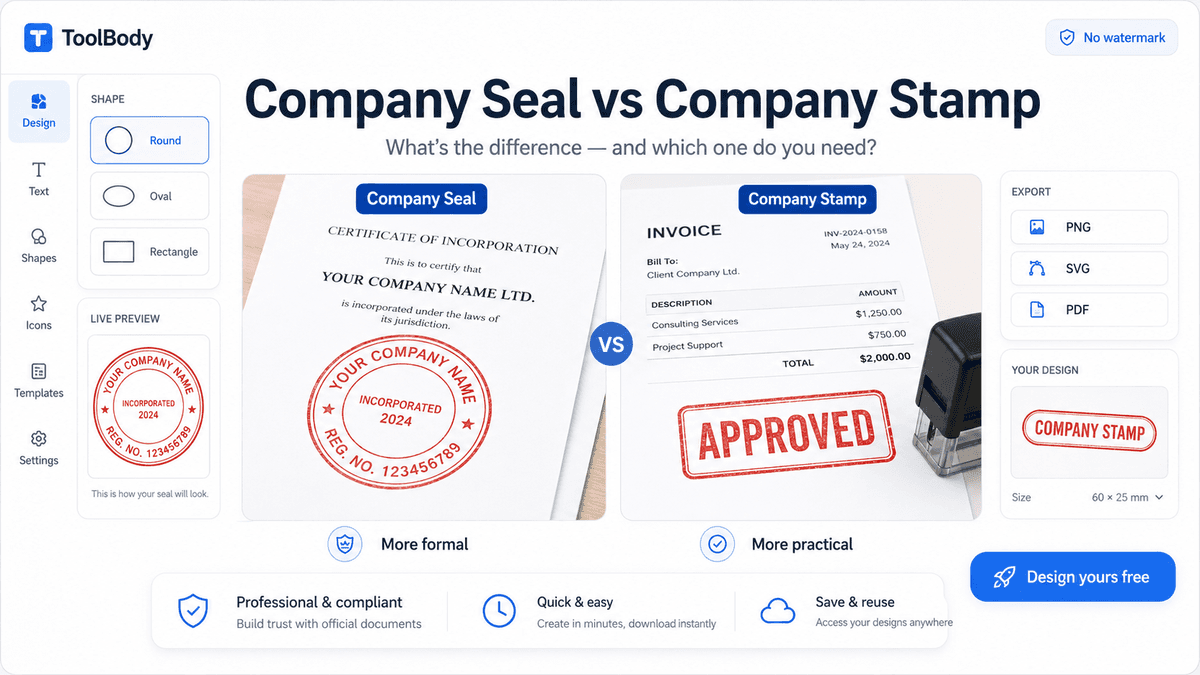
A company seal is a formal mark that historically authenticated official corporate documents. The original form was an embossed or wax impression - the company would press a die into wax (or later, into paper to create a raised pattern) to "seal" a document.
In modern practice, the physical wax-and-emboss tradition has mostly given way to printed or stamped images. But the concept of "the company seal as the formal corporate mark" persists in legal contexts in many jurisdictions.
What a company seal does (in jurisdictions that recognize it):
Represents the company as a legal entity
Authenticates corporate documents - resolutions, contracts executed under seal, share certificates, etc.
May satisfy formal execution requirements for documents that need more than just a signature
Carries weight that an everyday stamp doesn't, because it specifically marks the document as executed by the corporate entity
What a company seal does not do (anywhere):
Replace a director's signature on documents that legally require one
Override jurisdiction-specific requirements (a seal doesn't override notarization requirements, for example)
Function as a tamper-evident security mark (seals are visual; they don't include cryptographic authentication)
In practical terms, a company seal is a legal-entity mark rather than a branding mark. Its purpose is to identify the document as coming from the corporate entity in its formal capacity.
Typical company seal examples
A round seal with the company's full legal name on the outer arc and entity type ("Ltd", "Inc", "LLC") in the center
A bilingual seal for UAE businesses with the English company name on top and the Arabic name on bottom, license number in the middle
A circular seal with the company name, year of incorporation, and jurisdiction (state, country)
An embossed-style seal for printed certificates and formal corporate resolutions
Both seals and stamps can be designed using the same stamp maker - they just include different content. See the company seal templates for entity-specific seal layouts across UK, US, UAE, India, Singapore, and other jurisdictions.
When you need each
When a company stamp is enough
For the everyday operations of most small and medium businesses, a company stamp is enough:
Invoicing - a stamp on invoices adds professional polish and identifies the business
Letterheads - a stamp on formal correspondence does the same
Packaging - branded stamps on shipping boxes and paper bags
Internal workflow - APPROVED, PAID, RECEIVED stamps used by office staff
Marketing materials - flyers, brochures, business cards
Certificates - achievement certificates issued by the business
Contracts in informal contexts - between known commercial parties without formal execution requirements
If your work is mostly the above, a company stamp covers your needs and a formal seal is unnecessary.
When you might need a company seal
A formal company seal becomes relevant when:
You're executing documents "under seal" - some jurisdictions still recognize this concept for specific document types (contracts, deeds, share certificates in certain regions)
Your corporate constitution requires it - some companies' articles of association still specify that certain documents must bear the company seal
You're issuing share certificates - in some jurisdictions, share certificates traditionally bear the company seal
Your jurisdiction's company law specifically requires seal use for certain filings
A client or counterparty specifically requests a sealed document for their own legal or regulatory requirements
These are specialized situations. Most small business owners go years without needing a formal seal. If you're unsure, check your company's articles of association (the document filed when you registered the company) or ask your accountant or lawyer.
When you might want both
Some larger businesses maintain both:
A formal company seal for the rare formal corporate documents
A general company stamp for everyday operations
This is more common with established companies with formal governance structures than with startups or small businesses. Most small businesses pick one and use it for both purposes.
Are they legally required? (by region, general)
This section is a general overview. Specific legal requirements vary by jurisdiction, entity type, and document type - consult a lawyer or your jurisdiction's company law for binding answers.
United Kingdom
The Companies Act 1989 first made the common seal optional, with effect from 31 July 1990 rather than 1989. The modern authority is section 45 of the Companies Act 2006, which states that a company “may have a common seal, but need not have one”. Seals are still recognized if used, and some companies maintain them for traditional or constitutional reasons, but they're no longer mandatory for most documents. Section 44 of the Companies Act 2006 confirms that a document can be executed by signature instead of a seal, and that a document so signed has the same effect as if executed under the common seal. Section 45 does not extend to Scotland.
United States
Corporate seal requirements vary by state, but most states have moved away from mandating them. They're still used by tradition for share certificates and formal corporate documents. Banks sometimes still ask for seal use on certain corporate banking documents. Check your state's specific corporate code.
United Arab Emirates
The official company stamp is widely used and often expected on commercial documents - invoices, contracts, letterheads, embassy submissions for visa support letters, government filings. Bilingual English-Arabic layouts are standard. The Federal Law No. 2 of 2015 on commercial companies addresses stamping requirements. Different Free Zones (DMCC, JAFZA, RAKEZ, etc.) and Mainland regulations may have additional specific requirements.
India
The Companies Act 2013 made common seals optional - companies can choose whether to have one in their articles of association. For companies that have a seal, certain documents traditionally bear it (share certificates particularly). For companies without a seal, equivalent documents can be executed by signature.
Saudi Arabia and other GCC countries
Company stamps are widely used in daily business, often expected on invoices, contracts, and government filings. Bilingual stamps are standard. Specific legal requirements vary by entity type and jurisdiction.
Singapore
The Companies Act made seals optional in 2017. Many Singaporean companies have moved to signature-only execution.
Hong Kong
The Companies Ordinance allows companies to operate without a seal. Where a seal is used, it must follow specific format requirements.
Australia
Section 123 of the Corporations Act 2001 says a company “may have a common seal”, and section 127 sets out how to execute a document — including a deed — without one, by signature of two directors, a director and secretary, or the sole director of a proprietary company.
Canada
Federally incorporated companies are covered by section 23 of the Canada Business Corporations Act, under which a corporation may adopt a seal but need not, and a document is not invalid merely because no seal is affixed. Provincial statutes vary — some keep seal requirements for particular documents, others have moved to signature-based execution.
European Union member states
Wide variation. Germany doesn't generally require seals; France, Italy, and Spain have different conventions. Local advice is essential.
The general trend
The global trend is toward making seals optional rather than mandatory. Signature-based execution has become the dominant method for most documents. Seals persist in specific contexts (share certificates, certain formal contracts) and certain regions (particularly Asia and the Middle East where they remain culturally expected), but their legal necessity has decreased significantly across most jurisdictions.
Practical takeaway: unless you're sure your jurisdiction or your company's constitution requires a seal for specific documents, you can probably operate with a well-designed company stamp.
What to put on each
Standard elements for a company stamp
Required:
Company name (use your trading name or full legal name as appropriate)
Common additions (pick 2-3, not all):
Logo
Contact details (phone, email, website)
Tax registration number if applicable
Address (for return-mail stamps specifically)
Tagline or short slogan
Bilingual translation (essential for UAE/GCC, common for international businesses)
What not to add:
Too much text - cramming everything onto a stamp makes it unreadable
Anything that resembles a government, embassy, or court seal
Trademarks or symbols you don't own
Standard elements for a company seal
Required:
Full legal company name (the name as registered with the company registrar)
Entity type (LLC, Inc, Ltd, Pvt Ltd, FZE, etc.)
Common additions:
Year of incorporation
Registration or license number (required in some jurisdictions like UAE)
Jurisdiction (state, country)
Bilingual translation where culturally expected
What not to add:
Marketing copy or slogans (seals are formal, not promotional)
Logos in jurisdictions where seals must be strictly formal
Anything that's not part of the company's registered legal identity
When formatting both for the same business
If you're designing a stamp that will function as both a stamp and a seal:
Use the full legal name (so it can serve formal contexts)
Include the entity type
Add a logo if your jurisdiction allows it on formal seals (most do)
Keep supporting text minimal so the design works in both formal and everyday contexts
This dual-purpose approach is what most small businesses end up with - a single round stamp that serves all their stamping needs.
How to create one free online
The good news: you can design either a company stamp or a company seal in about three minutes using a free online stamp maker, with no sign-up and no watermark.
Step 1 - Open the stamp maker
Go to the stamp maker in your browser.
Step 2 - Pick a shape
Round is the standard for both seals and general business stamps. Pick oval if your company name is long. Rectangular works for address-style stamps.
Step 3 - Add your business name
Type your business name as curved text on the top arc. For a seal, use your full legal name; for a general stamp, your trading name is fine.
Step 4 - Add supporting elements
For a seal: entity type ("LLC", "FZE", "Pvt Ltd") in the center, year of incorporation or registration number on the bottom arc.
For a stamp: logo in the center (upload if you have one) or trading name on the top arc with city or website on the bottom arc.
Step 5 - Choose a color
Blue is the most common for business stamps and seals. Red for high-attention stamps. Black for formal seals.
Step 6 - Download
Export as transparent PNG for digital use (placing on invoices, PDFs, Word documents) or SVG for ordering a physical rubber stamp from a print shop. Save both formats so you have flexibility.
Step 7 - Use it
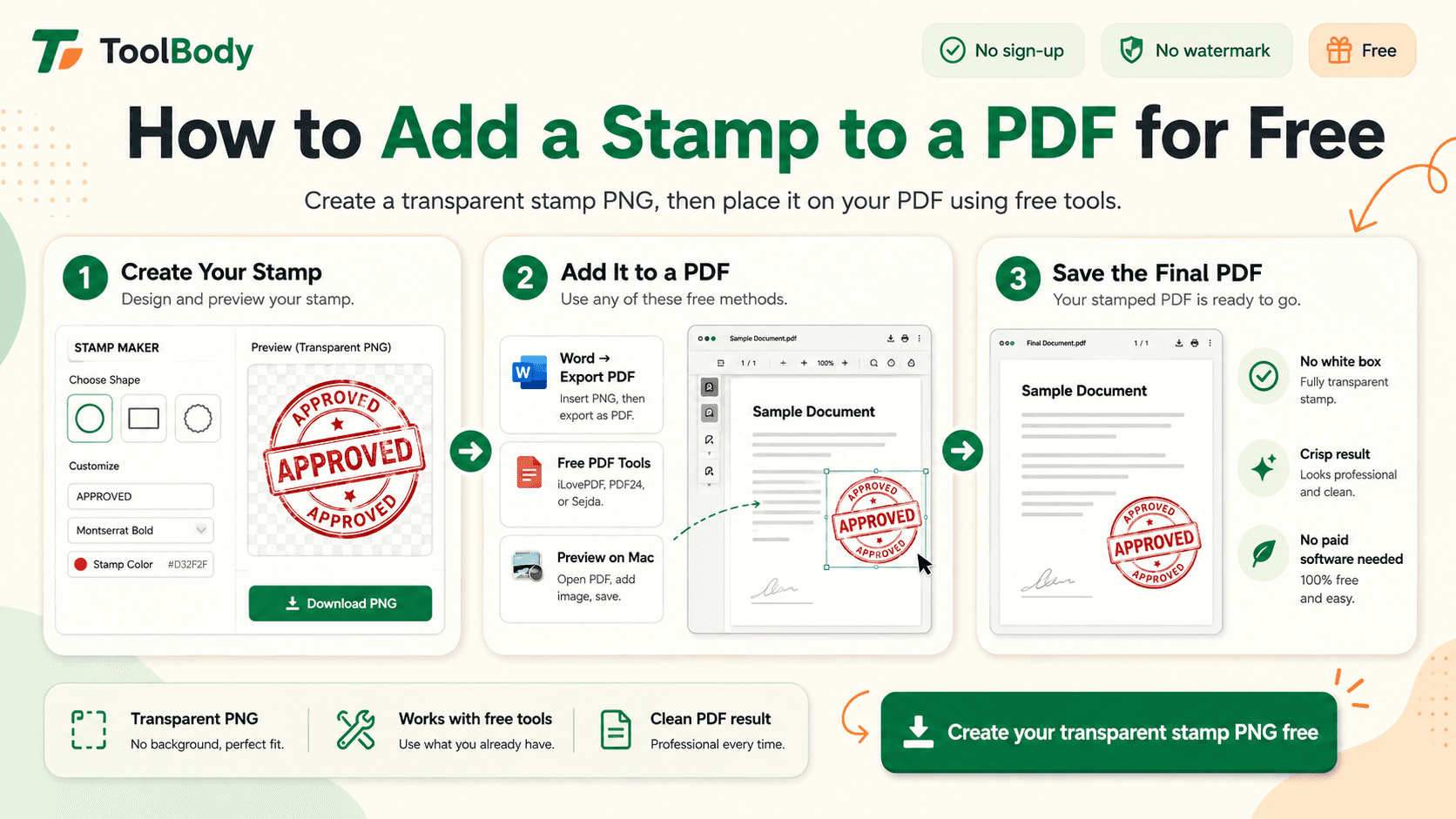
Apply the PNG to digital documents directly - or follow our guide on how to add a stamp to a PDF for the step-by-step. For physical use, send the SVG file to any rubber-stamp manufacturer with dimensions in millimeters.
What it costs
The design step on ToolBody is free. The physical rubber stamp version (if you want one) typically costs $15-30 from local print shops or online rubber-stamp manufacturers. Compare to hiring a designer for the design step, which would normally cost $50-200.
Common mistakes and how to avoid them
Mistake 1 - Treating a stamp and a seal as interchangeable for legal purposes If your jurisdiction or company constitution specifically requires a sealed document, a general company stamp may not satisfy the requirement. Check your local law for specific document types.
Mistake 2 - Putting too much information on a seal A formal seal should be minimal - company name and entity type. Adding contact details, taglines, or marketing copy makes a "seal" look like an everyday stamp and undermines its formal purpose.
Mistake 3 - Putting too little information on a stamp A general business stamp benefits from elements that make it useful (logo, contact info). A stamp with just "ACME Co." misses the chance to communicate your business clearly.
Mistake 4 - Inconsistent stamps across different documents Pick one design for your company stamp (or seal) and use it consistently. Switching designs makes your business look disorganized.
Mistake 5 - Imitating government, embassy, or notary seals Even if your business name is on the design, anything that visually resembles an official authority mark can be illegal and gets your business into trouble. Keep the design clearly distinct from regulated authority marks.
Mistake 6 - Using a JPG instead of a transparent PNG JPG files have white backgrounds that appear as a white box around the seal or stamp on documents. Always export as transparent PNG (or SVG) for clean placement.
Putting it into practice
The shortest version of this entire guide:
If you're a typical small business, design a single round company stamp with your name, logo, and 1-2 supporting details. Use it for everything. Don't worry about whether it's "technically a seal" - the visual mark serves your business needs.
If you're in a jurisdiction that still uses formal seals (some UK and Commonwealth contexts, some US corporate filings), design a minimal formal seal with just your full legal name and entity type. Keep your everyday stamp separate.
If you're not sure which applies, design a clean round stamp with your full legal name, entity type, and a logo in the center. This dual-purpose design works as both an everyday stamp and a formal seal for almost every practical situation.
All three approaches can be designed in the same free online stamp maker, saved as transparent PNG and SVG, and used immediately on digital documents or sent to a print shop for physical production.
Related guides
The free stamp maker - design either a company seal or a general company stamp
Company seal templates - entity-specific seal layouts for UK, US, UAE, India, Singapore, and other jurisdictions
How to add a stamp to a PDF - applying your finished seal or stamp to digital documents
How ToolBody works - overview of the three-tool workflow for business documents
FAQs
A company seal is a formal mark that historically authenticated official corporate documents and in some jurisdictions still carries legal weight on its own - it represents the company as a legal entity. A company stamp is a general-purpose ink stamp used for everyday business document marking like invoices, letterheads, and packaging. Stamps carry the company's identity but don't usually have the independent legal authority that seals do. In practical modern use, the terms are often confused or used interchangeably.
It depends on your jurisdiction. In the UK, common seals stopped being mandatory in 1989 (Companies Act 1989) but are still recognized if used. In the US, most states no longer require corporate seals but they're still used by tradition. In India, the Companies Act 2013 made common seals optional. In the UAE, official entity stamps with TRN and license numbers are widely used and often expected on commercial documents but specific 'seal' requirements vary by Free Zone or Mainland jurisdiction. In many parts of Asia and the Middle East, company stamps are essential for daily business even when not strictly required by law. Check your local company law or with a lawyer if you're unsure.
Often yes, depending on what you're using it for. For everyday business documents - invoices, letterheads, internal workflow - a company stamp is sufficient and a formal seal isn't required. For high-stakes legal documents in jurisdictions that recognize seals (some UK and Commonwealth contexts, some US corporate filings), a formal seal carries weight that a regular stamp doesn't. For most small businesses globally, a well-designed company stamp serves both purposes.
These terms are largely interchangeable. Corporate seal is more common in US legal contexts; company seal is more common in UK and Commonwealth contexts. Both refer to the formal mark used to authenticate documents on behalf of the corporate entity. There's no functional difference in how they work - just regional terminology preferences.
Standard elements: the company's full registered name, the entity type (LLC, Inc, Ltd, Pvt Ltd, FZE, etc.), and often the year of incorporation. Some jurisdictions also require registration or license numbers. The design is typically circular with the name on the outer arc and the entity type or year in the center. For UAE and GCC seals specifically, bilingual English-Arabic layouts are standard. For India and Pakistan, the registration number under the Companies Act is often included.
More flexibility than a seal. Common elements: company name (could be the trading name rather than the full legal name), logo, contact details (phone, email, website), tax registration number if applicable, and city or country. For a general-use business stamp, less is more - a clean logo with the company name and one or two key supporting details reads more professionally than a stamp packed with information.
Yes. You can design both a formal company seal and a general company stamp in the free online stamp maker. Pick the shape (round is standard for both), upload your logo if you have one, add the required text elements (company name, entity type for seals; contact details for general stamps), choose colors, and download as transparent PNG for digital use or SVG for ordering a physical rubber stamp. No sign-up, no watermark, no daily limit.
For everyday business document use, a digital seal (PNG or SVG image) placed on documents has the same practical effect as a physical seal in modern business practice. For specific legal proceedings or documents requiring formal embossing in jurisdictions that still recognize that requirement, a physical seal may still be needed. For everything else - invoices, contracts between commercial parties, letterheads, certificates, internal documents - a clean digital seal image works in practice.
Most small and medium businesses only need one. Pick whichever fits your use cases - if you're issuing formal corporate documents in a jurisdiction where seals are recognized, design a formal seal. If you're marking general business documents and care more about branding, design a general company stamp. Some businesses have both - a formal seal for legal corporate documents and a general stamp for everyday operations - but it's not necessary unless your workflow specifically calls for the distinction.
Conventional placement: bottom-right of the document, near the authorized signature. For company letterheads, sometimes top-right as a header brand mark. For invoices, near the total or in the signature area. For certificates, centered at the bottom. The placement matters less than visibility - the seal or stamp should be clearly visible without competing with the document's main content.